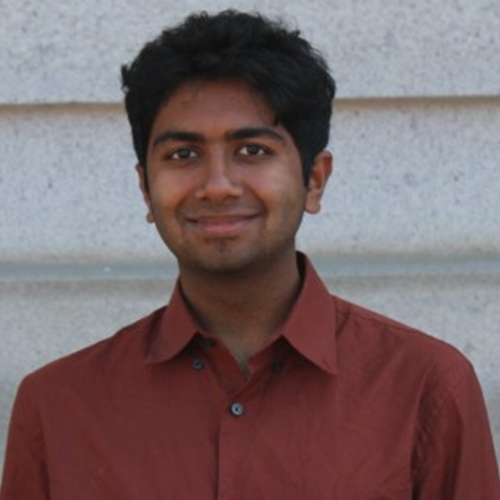
Rohit Jha

Rohit is a senior at UC Berkeley triple-majoring in Computer Science, Data Science, and Statistics. He is the external vice president of Political Computer Science, a student-led organization which aims to promote non-partisan discussion in regards to the role of policy in technology (and vice versa). He is the External Vice President at Political Computer Science @ Berkeley, and joined the organization as a general member, then served as a project manager before becoming the organization’s EVP. Outside of Political Computer Science, he is involved at Berkeley as a director in another data science organization, and working in the campus’ visitor services department by giving tours to visitors from around the world and greeting them at iconic campus landmarks like the bell tower and football stadium. Beyond his work at Berkeley, Rohit has completed summer internships at Walmart and AXA, and aspires to work in data science post-graduation.

What causes are you most passionate about?

I am extremely passionate about achieving social justice. Throughout my life, I have seen many peers from underrepresented backgrounds face hurdles in both their personal and professional lives. These hurdles could range from explicit racism to more implicit microaggressions or weird comments regarding their identities. Given my background as an Indian student, I have been in such a position myself, and knowing how this discomfort feels, I am driven to make my world more of a safe space for anybody. 

If you could make one improvement in the world, what would it be?

If I could make one improvement in the world, I would increase access to basic education to everybody. The power of a quality education can make anybody’s life so much easier. Not only does it open the doors for opportunity, it empowers better communication within people, and helps sharpen ideas for innovation. Making the world more educated will sharpen the world’s progress, and advance humankind into territory we couldn’t even dream of in the present. 

What ideas or efforts do you think will have changed the world the most?

I think the idea of the world-wide-web is what changed the world the most. It was able to connect the world like no way before and brought in so many new technologies when it launched. Beyond this, it did wonders for making information more easily accessible and archiving history forever. As the internet continues to grow, it will be interesting to see the new good that it does for the world, and the efforts that go underway to minimize any negative effects. 

Annika Burman

Annika is a student at the University of Michigan double majoring in International Studies and Asian Studies with a focus on Korean and Chinese studies. In Summer 2024, Annika founded Roundtable, an organization that aims to decrease political polarization and increase critical thinking on college campuses. Members of Roundtable learn about America’s most evergreen political questions through scholarly studies and arguments from across the political spectrum. Taking lessons from psychologists and studies on polarization, Roundtable creates a space where students are encouraged to approach ideas with curiosity, compassion, and rigor. Annika joined the Impact Public Service Fund’s University Fellowship Program because she believes Roundtable’s mission is incredibly important but difficult to actualize. Fortunately, Impact Public Service Fund provides resources, advice, and a network of inspiring peers and mentors who can guide her in creating the most effective student organization possible. With the support of Impact Public Service Fund, Annika hopes to build an organization that will leave a long-lasting impact on the student community at the University of Michigan and sustain itself even after she graduates. Outside of Roundtable and the Fellowship, Annika is Co-president of the Effective Altruism club, a club sports athlete on the Ballroom Dance Team, and a member of the Alexander Hamilton Society. In her free time, she enjoys songwriting, social dancing, reading, and studying foreign languages. 

What causes are you most passionate about? 

Loneliness. Time and time again, happiness studies show that the quality of our close relationships is the biggest determiner of our happiness. People with strong relationships live longer, healthier, happier lives. However, many highly-developed countries are facing loneliness epidemics, and my generation is turning away from the traditional paths of marriage and childbirth, weakening our social networks even further. I am passionate about exploring the effects of this trend on mental health and loneliness rates, as well as finding community-wide solutions to decrease loneliness. 

I am also passionate about electoral reform! Most people have heard of Ranked-Choice Voting, but have you heard of the far-superior STAR voting? 

If you could make one improvement in the world, what would it be? 

Increase human connection. Decrease loneliness. 

What ideas or efforts do you think will or have changed the world the most? 

Capitalism and Artificial Intelligence.

Amarachi Ngadi

Amarachi is a second-year Master of Public Administration (MPA) student at the NYU Wagner School of Public Service, specializing in Advocacy & Political Action. Her academic and professional focus is on addressing systemic inequalities through public policy and direct service efforts. Recently, Amarachi worked as a legislative fellow for a New York City Council Member, where she researched proposed legislation that would directly impact vulnerable populations in Brooklyn, NY. Her work involved analyzing the potential impact of new policies on housing, economic stability, and social services to create a more equitable city. Before her fellowship, she worked as a Homeless Outreach Specialist, connecting individuals experiencing street homelessness with temporary shelter arrangements. This has fueled her passion for addressing the root causes of poverty and instability in low-income and marginalized communities. After graduation, she plans to continue her research and advocacy by focusing on solutions to the ongoing homelessness crises in NYC and California. 

What causes are you most passionate about?

I am most passionate about uplifting marginalized and commonly overlooked communities, specifically black populations, women, and impoverished groups. Many individuals experiencing homelessness require resources other than just housing. I believe we must acknowledge the socioeconomic factors that have contributed to their current situation and determine how we can assist their transition to stable housing to ensure they are mentally, emotionally, and physically able to maintain a stable home.

What ideas or efforts do you think will or have changed the world the most?

Future efforts to build relationships between Overdose Prevention Centers (OPCs) and Homeless Shelters will significantly improve the services offered to a perpetually underserved community. Mental illness and addiction maintain an ingrained causal relationship with poverty, which must be addressed when creating homelessness policies. I believe that the drug epidemic requires a public health approach as opposed to criminalization and this initiative could provide clients with an opportunity for rehabilitation within the shelter system and establish a safe environment for unhoused individuals to determine their path toward resolving their circumstances. 

My ideal future world includes…

Increased protections against housing discrimination for all and more targeted services for unhoused individuals struggling with mental illness and/or addiction.