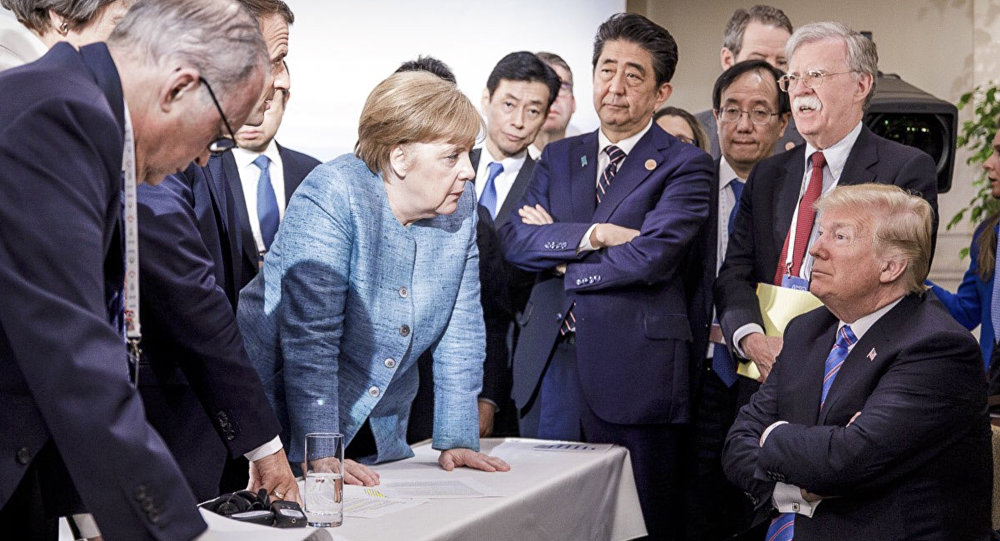
We are in the midst of a great change in the international order. For my parents’ entire lifetime, the story of world politics was largely the story of increasing globalism, foreign trade and the building of international institutions from the U.N. to N.A.T.O. to the European Union.
Now, all around the world, we see a movement toward greater nationalism and populism and the weakening of institutions. That success or failure of that movement will define the politics of the twenty-first century and affect the daily life of billions of people. Here are a variety of analyses along this theme.
- The Return to Great Power Rivalry Was Inevitable – The Atlantic
- Is This The End of The American Century? – London Review of Books
- The New German Question – Foreign Affairs
- China’s Massive Belt and Road Initiative – Council on Foreign Relations
- Will John Bolton Bring on Armageddon or Stave It Off? – The Atlantic
Read widely. Read wisely.
Max
RECOMMENDED READINGS
1. The Return to Great-Power Rivalry Was Inevitable
The Atlantic (14 min)
Summary
The author argues that the interests of Russia, China and the U.S. are diverging in a way that will disrupt the “liberal international order.”
Selection
It has now become clear that we are in the early stages of a dramatic change in world politics that necessitates a change in strategy. For several years now, geopolitical competition between the major powers has been intensifying. Russia became much more aggressive in Eastern Europe and the Middle East. China grew more assertive in East Asia. What we did not know, until very recently, was that this competition would also directly and negatively impact the lives of citizens in Western democracies. Examples abound: Russia’s attack on American democracy. Cyberattacks on critical infrastructure, including the power grid. Chinese political interference, including pressure on American companies, especially in the media and social-media sector. The mass theft of intellectual property. The collection of private data by foreign powers. The strategic use of corruption to build networks of support. And backing for authoritarian movements in countries that were, until several years ago, stable democracies. These may seem like isolated or disconnected incidents. But they are not. They are deeply embedded in the logic of the emerging great-power competition, and they will only get worse. To understand why, we need to look at how we got here.
London Review of Books (29 min)
Summary
There is a difference between American power and American political authority. American power has never been greater. But American authority around the world is decreasing at a precipitous rate. American influence around the world is not what it once was and may never return.
Selection
At G20, G7 and Nato summits, the mood is tense. The rumour that the US is planning to charge host governments ‘cost plus 50 per cent’ for the military bases it has planted all over the world is the latest instance of a stance that at times seems to reduce American power to a protection racket. But for all the indignation this causes, what matters is the effect Trump’s disruptive political style has on the global power balance and whether it indicates a historic rupture of the American world order. How much difference does the US being rude to European Nato members, refusing to co-operate with the WTO, or playing hardball on car imports really make? This is not merely a debating point. It is the challenge being advanced by the Trump administration itself in its encounters with its allies and partners. Do America’s alliances – do international institutions – really matter? The administration is even testing the proposition that transnational technological and business linkages must be taken as given. Might it not be better for the US simply to ‘uncouple’? Where Trump’s critics argue that at a time when China’s power is increasing the US should strengthen its alliances abroad, the Trumpists take the opposite view. For them it is precisely in order to face down China that the US must shake up the Western alliance and redefine its terms so that it serves American interests more clearly. What we are witnessing isn’t just a process of dismantling and destruction, but a deliberate strategy of stress testing. It is a strategy Trump personifies, but it goes well beyond him.
Foreign Affairs (21 min)
Summary
The failure of the European project, if it occurs, could be a nightmare, and not only for Europe. It will, among other things, bring back what used to be known as “the German question.”
Selection
The German question produced the Europe of today, as well as the transatlantic relationship of the past seven-plus decades. Germany’s unification in 1871 created a new nation in the heart of Europe that was too large, too populous, too rich, and too powerful to be effectively balanced by the other European powers, including the United Kingdom. The breakdown of the European balance of power helped produce two world wars and brought more than ten million U.S. soldiers across the Atlantic to fight and die in those wars. Americans and Europeans established NATO after World War II at least as much to settle the German problem as to meet the Soviet challenge, a fact now forgotten by today’s realists—to “keep the Soviet Union out, the Americans in, and the Germans down,” as Lord Ismay, the alliance’s first secretary-general, put it. This was also the purpose of the series of integrative European institutions, beginning with the European Steel and Coal Community, that eventually became the European Union. As the diplomat George Kennan put it, some form of European unification was “the only conceivable solution for the problem of Germany’s relation to the rest of Europe,” and that unification could occur only under the umbrella of a U.S. security commitment.
Council on Foreign Relations (12 min)
Summary
Primer on the largest infrastructure project of all time – designed to advance China’s interests and increase China’s influence around the world.
Selection
Some analysts see the project as an unsettling extension of China’s rising power, and as the costs of many of the proposed projects have skyrocketed, opposition has grown in some participant countries. Meanwhile, the United States shares the concern of some in Asia that the BRI could be a Trojan horse for China-led regional development, military expansion, and Beijing-controlled institutions. Under President Donald J. Trump, Washington has raised alarm over Beijing’s actions even as it has abandoned some U.S. efforts to isolate China and deepen its own ties with economic partners in the region and as the costs of many of the proposed projects have skyrocketed, opposition has grown in some participant countries. Meanwhile, the United States shares the concern of some in Asia that the BRI could be a Trojan horse for China-led regional development, military expansion, and Beijing-controlled institutions. Under President Donald J. Trump, Washington has raised alarm over Beijing’s actions even as it has abandoned some U.S. efforts to isolate China and deepen its own ties with economic partners in the region.
5. Will John Bolton Bring on Armageddon—Or Stave It Off?
The Atlantic (34 min)
Summary
Great article. A profile of Bolton, the most experienced and possibly the most important influencer in Trump’s administration for national security issues.
Selection
“I would describe myself as pro-American,” Bolton said. “The greatest hope for freedom for mankind in history is the United States, and therefore protecting American national interest is the single best strategy for the world.” He said that America has slowly constrained its range of action, through foolhardy entanglements with international institutions such as the United Nations, and naive bilateral agreements that promised too much to America’s enemies in exchange for too little. He saw bad deals all around: The INF Treaty, which even Barack Obama’s administration said Russia had violated with impunity, was one. The Iran nuclear agreement, which Bolton has labored tirelessly to scrap, was another… Bolton sees the UN, and fans of international law more generally, as a clutch of nattering spouses, trying to get Uncle Sam to modify his behavior. The international-law professoriat is a “dangerously underworked group of people,” he told an audience in 2011, who “are dissatisfied with the political outcome that they’ve achieved in our system, and who have determined to take their arguments into the broader international context” as a way to force America to do what voters have rejected. “Within the United States, we’re fully capable of deciding what our policies should be,” Bolton told me. “That includes environmental issues, the death penalty, gun control, abortion—all of which are hotly debated in America, and on all of which the majority position is different from the overwhelming majority in Europe.” Here his view on international law intersects with the Trumpian notion of a deep state: a corps of unelected monitors who obstruct the democratically chosen sovereign. Globalism and multilateralism, he said, constitute a way to appeal an electoral loss to “the government of the world.”
Postscript
As more candidates throw their hats in the ring for the U.S. presidency, there will be a lot of talk about Trump, about universal health care, and about the economy. There will be precious little time will be given to international relations. That is a mistake because America’s role in the world affects our security, or economy, and our own political legitimacy.
Some of the Big Questions are:
- If the the 21st Century becomes “the Chinese century” what will that look like? China is building alliances through trade and infrastructure projects while the U.S. is withdrawing support for some of its allies. Is talk of foreign influence just ephemeral nonsense, or will China’s authoritarian view of the world become more accepted and encourage other countries to stray from the path of democratic government?
- Will Russia continue interfering with our elections?
- Will the European Union survive Brexit? Will it survive if France elects Le Pen and withdraws its support of the EU? Will Germany continue to suppress it’s own interests for the good of the union?
- Will North Korea be any less dangerous as Kim Jong Un meets more frequently with other world leaders?
- Will the U.S. continue to withdraw from treaties on weapons, trade and climate? Will Trump withdraw U.S. funding and leadership in NATO?
As Trump has picked fights with our allies (Germany, France, Canada) and made friendly with our enemies (Putin, Kim Jong Un) global politics seems upside down. There is a serious live question about the role of the U.S. in the world and about the role of international institutions in the political life of the U.S. Is it better for a people to limit their sovereignty in order to form cooperative bonds with other nations for shared goals? Or should people avoid the constraints of being governed by bureaucrats they do not know and did not elect? This is one of the central disagreements between conservatives and liberals. Conservatives dislike “big” government, which not only means expensive government but also far-away government that isn’t close to or accountable to the people being governed. Liberals dislike people not being given the protections and rights they feel aren’t protected when values aren’t institutionalized enough.
We are witnessing a big experiment in the dismantling of international institutions. Only time will tell what the results of that experiment will be.
– Max