Reflections from an historic week
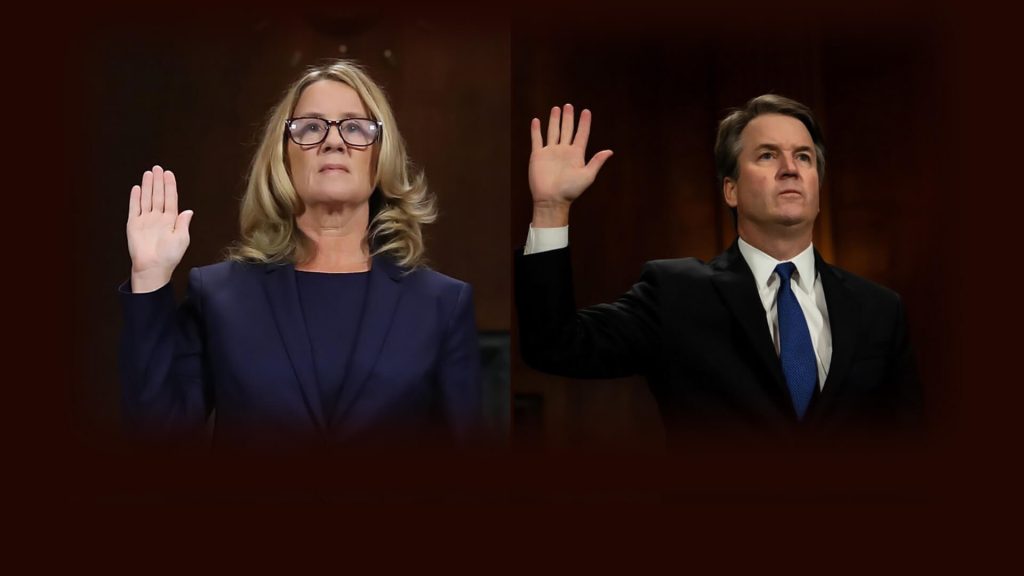
The most important discussion in America this week is the Supreme Court confirmation process and allegations that Judge Brett Kavanaugh sexually harrassed Christine Blasey Ford and other women.
My bet is that you, like me, are reading and watching a lot about this, so I’m not sending links to more “news” about it.
I’m sharing some broader thought pieces I’ve found helpful in thinking through what these events portend for this country. The first is about the implications of a conservative Supreme Court. The second explores whether true conservatism can exist in America today. The third is a diagnosis of how our society has moved into a post-truth era.
I’m only sharing three. I’m limiting the amount in hopes you’ll get to read get to read them all.
Read widely. Read wisely.
RECOMMENDED READINGS
1. What happens to the Supreme Court if Kavanaugh is Confirmed?
“Tipping the Scales” – New York Review of Books (15 min)
Summary
A mostly balanced analysis of what to expect from a conservative-dominated Supreme Court, looking at the impact on abortion rights, to environmental regulation, to affirmative action. Interestingly, the author predicts that gay marriage would not be reversed. Good, clear, articulation of some of the big issues at stake.
Selection
“The current Court’s four consistent conservatives are all substantially younger than Kennedy, Ginsburg, and Breyer. The oldest, Clarence Thomas, is sixty-nine. Samuel Alito is sixty-eight, Chief Justice John Roberts is sixty-three, and Neil Gorsuch is just fifty.
“All are self-described constitutional originalists; all favor interpreting statutes based on text rather than their intention; and all have strongly pro-business judicial records. Should Trump appoint a fifth conservative—to say nothing of a sixth or seventh—the conservative majority could easily last a generation…”
2. What does it mean to be conservative?
“America Desperately Needs a Healthy Conservatism” – by Andrew Sullivan in New York Magazine (20 min)
Summary
Andrew Sullivan is so interesting. He is a self-professed conservative, homosexual Catholic. Maybe that unusual combination forces him to think deeply about things – he’s always an outsider in some group, needing to defend his views. In this piece, he reflects on the idea of conservatism – what it means and why, in his opinion, it is at risk of extinction as a political force in America.
He gives a short tour through the history of conservative political thought then explains why he thinks conservatism is at risk from the left, and, especially, from the Republican party.
I was particularly interested in his views on immigration: he thinks that a) the West has acted as if there is no limit to the good brought by on diversity and immigration and b) this behavior has proven disastrous to our shared political community.
This is worth your time.
Selection
As a temperament, conservatives are prone to obey as passionately as liberals are prone to rebel. They prefer order to change, stability to upheaval, authority to anarchy. And so a conservative is likely to see, say, the flag as an object of veneration, the Constitution as something to be protected rather than altered, the nation as demanding a loyalty before all other claims, especially those of ideology, tribe, gender, or race. The conservative immediately saw why Fascism and Communism were evil; they were intent on obliterating settled ways of life, destroying the individual in favor of a collective, empowering the state so that it destroyed the civil society that made liberalism thrive. No conservative ever wants to purify anything. It’s the human mess that we love, with its intimations of how to improve it.”
3. Have we moved beyond truth?
“The revolt of the public and the “age of post-truth”” – by Martin Gurri in The Fifth Wave (25 min)
Summary
Fascinating theory on how the public’s lost faith in “truth” stems from it’s lost faith in “elites.” Gurri argues that “The sociopolitical disorders that torment our moment in history, including the fragmentation of truth into “post-truth,” flow primarily from a failure of legitimacy, of the bond of trust between rulers and ruled. Everything begins with the public’s conviction that elites have lost their authorizing magic.”
The idea of “truth” in any culture, says Gurri, is established and protected by the elites whom the culture admires. We are living at a time when the elites have lost their sway, so we are living in a time where the idea of “truth” has lost its sway too.
Selection
Three years ago I remarked that the public was engaged in a messy divorce from the elites who run the great institutions of the industrial age. That bit of scandal is by now notorious. The elites, with more to lose, have come to regard the intrusive public as little better than a barbarian horde. They know that a complex society can’t be managed without expertise, and long to return to a past in which the expert’s dictates went unquestioned.
The public, however, has so far proved irresistible, and the breach appears irreconcilable. Established institutions, the political process, the economy, “the system,” all look to the public suspiciously like a lottery rigged in favor of the perpetual winners: a class of insiders who manage to be both self-righteous and self-serving, arrogant and failed.
But something even stranger is going on. We are told, by impeccable sources, that the public is experiencing a traumatic rupture with the truth. The post-election panic over “fake news” has hardened into a theory of universal self-deception.
So here we have the public stumbling into two terrible relationships – with the elites and with the truth – at the same time. The obvious question is why.
The answer, of course, is that the two relationships happen to be one and the same.”
Postscript
BEYOND TRUTH
It has been a remarkable week. I never thought I would see the Senate call for an FBI investigation into a Supreme Court nominee. But here we are.
Last night David Brooks remarked that in his conversations and Twitter feed he found a near perfect correlation between whether someone believed Blasey Ford or Kavanaugh and whether that person voted Republican or Democrat in the last election. Not only that but he said, more often than not, whatever side someone came down on, that person couldn’t imagine a reasonable person possibly believing the opposite.
Senator Jeff Flake did the country a favor by calling for an FBI investigation. Whatever they come back with, it will be a better outcome than if Kavanaugh were rammed through the process.
MISSED OPPORTUNITY
But Kavanaugh and the Republicans missed an opportunity, argued the editors at Axios, to bring the country together. What if, instead of just fighting back against the Democrats and proclaiming his innocence, Kavanaugh had demonstrated some empathy?
What if he had concluded his testimony by saying what nearly everyone was thinking: Christine Ford seems sincere and it seems reasonable that something terrible happened to her. “Therefore I call for an FBI investigation into what happened. I know I’m innocent so I have nothing to fear. I can only hope the investigation might bring the true perpetrator to justice.” He would have appeared more innocent, and maybe even heroic, in the way Flake is being hailed. A
As Axios publisher Jim Vandehei put it: “He [Kavanaugh] and Republicans had an epic failure of imagination. They were forced reluctantly and publicly into what should have been a fairly easy-to-anticipate moderate compromise: agree to a vote after a quick FBI probe. Instead of looking hungry for truth, Kavanaugh heads into the week looking fearful of findings.”
Leading the call for an investigation wouldn’t have just been good politics. It would have just been the virtuous thing to do. But the repeated failure of elites in our society to do the virtuous thing is what has led to the disintegration of the public’s trust in them. Martin Gurri explains Jose Ortega y Gasset’s thinking on this:
In the right relation between elites and the public, the former act as exemplars to the latter. They embody and live out the master narratives. (George Washington returning to his farm after the Revolution is a striking example.) The quality that sets elites apart – that imparts authority to their actions and expressions – isn’t power, or wealth, or education, or even persuasiveness. It’s integrity in life and work. “A healthy society is one in which such exemplary types draw the public toward them purely by the force of their example. Without compulsion, the bottom aspires to resemble the top, not superficially but fundamentally, because it wishes to partake of superior models of doing or being. The good society, Ortega concluded, was an “engine of perfection.”
Something in me revolts against this notion of a great mass looking up to benevolent and noble elites who serve as role models. It seems undemocratic and classist in a way that makes my skin crawl. But the alternative of having no one worth looking up to feels experientially much worse. When the leaders of your government and your largest companies and the the most prominent media personalities show themselves to have despicable dark sides, one can’t help but begin to think that the only way to get ahead is not through cultivation of one’s character, but by pure luck and naked power grabs. I’m pretty sure that’s not the lesson I want my children to learn.
INSTITUTIONS CRUMBLING
We are witnessing an epic destruction of institutions and public leaders. Supreme Court nominees, 80s sitcom comedians, and TV network CEOs, are being taken down by allegations of sexual harassment. Police departments are facing distrust in the wake of videos showing police using unnecessary force and violence. The Catholic church is reeling from a new wave of allegations of widespread sexual abuse by clergy in Philadelphia. Institutions and cultural leaders are crumbling under the weight of their own lack of integrity.
Conservatives should mourn the slide of institutional and elite leadership but this is healthier than the alternative – ceding cultural leadership to those who abuse their power and abuse others. One can only hope that out of this destruction and chaos we can begin rebuilding a society in which we call each other to higher standards and learn to trust one another again.
CONSERVATIVES AND CHARACTER
Andrew Sullivan wrote this about conservatism:
“For conservatism, society is for no end and no purpose; it is valuable simply in itself, as the combination of traditions, landscapes, communities, and customs that define a nation, bind us together as citizens, and make us feel at home. And yes, that feeling of being at home is nebulous. It is in many ways sub-rational. Ask ordinary people to describe it and they will often not be articulate. Sometimes, it manifests itself as bigotry, yes. Most of the time, it is about loss, and mourning it, while understanding that change is inevitable. Burke famously saw society not as a contract between individuals, but as a contract between generations: to pass on to the future the good and viable things we inherited from the past. This emphatically does not mean resistance to all change. In fact, it understands some change as critical to conservation. And perhaps that’s where American conservatism began to go wrong. The goal is not to stand athwart history and cry “Stop!”, as William F. Buckley put it. It’s to be part of the stream of history and say: slow it down a bit, will you? ”
I’m not interested in a biting, pugilistic, angry conservatism, resembling the old man yelling at the neighborhood kids to “Get off my lawn!” I’m interested in the conservatism that is seeking with good humor and good intentions “to pass on to the future the good and viable things we inherited from the past.”
I don’t know Judge Kavanaugh and can’t say I’ve read enough to have an educated opinion of him as a Justice. I also don’t know how I would react if I were publicly accused of the things he has been accused of. I just wish, that this week he had not shown himself to be a partisan warrior and instead had been more someone who, if he is innocent, was confident enough in his own innocence to show empathy for a woman who sincerely seemed to think he had wronged her.
When selecting our leaders, we must ask ourselves, be they Supreme Court Justices, or CEOs or Presidents, how much do we value the policies they will support and how much do we value their character? For a long time, in my view, both parties and may corporate boards have prioritized policies to the detriment of all else. And I think we are reaping what we’ve sown for years. Maybe it is time to rethink our moral calculus.
Read widely. Read wisely.
– Max